What If NFC Is the Heart of the Event? A Perfect NFC Event Design Through Google PLAYTIME 2025 Korea
Using the Google PLAYTIME 2025 Korea case study, this post breaks down how NFC badges, Androidify avatars, networking scores, a treasure hunt, session QR quizzes, demo booth reader tagging, and a real-time leaderboard were connected into a single NFC event design.
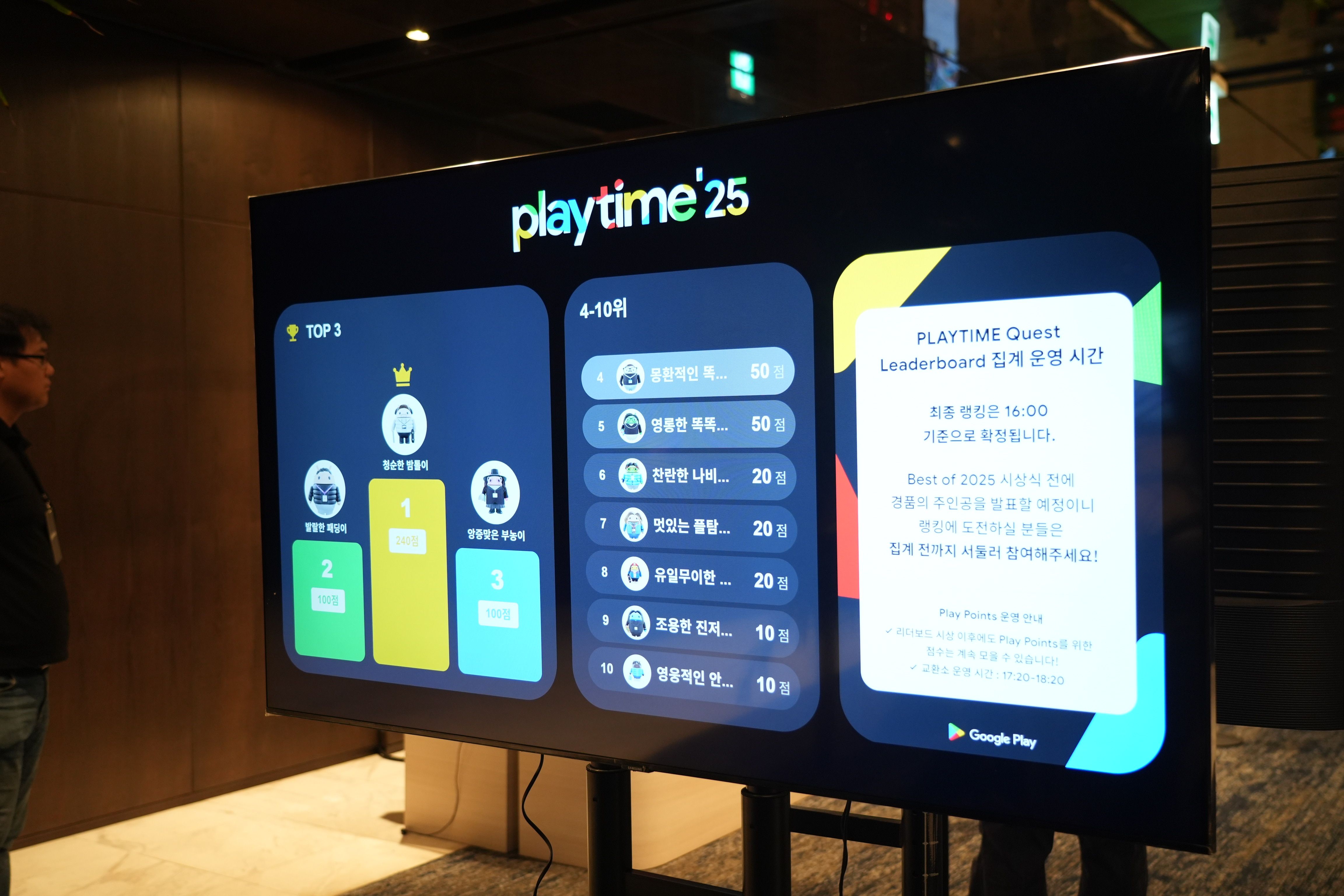
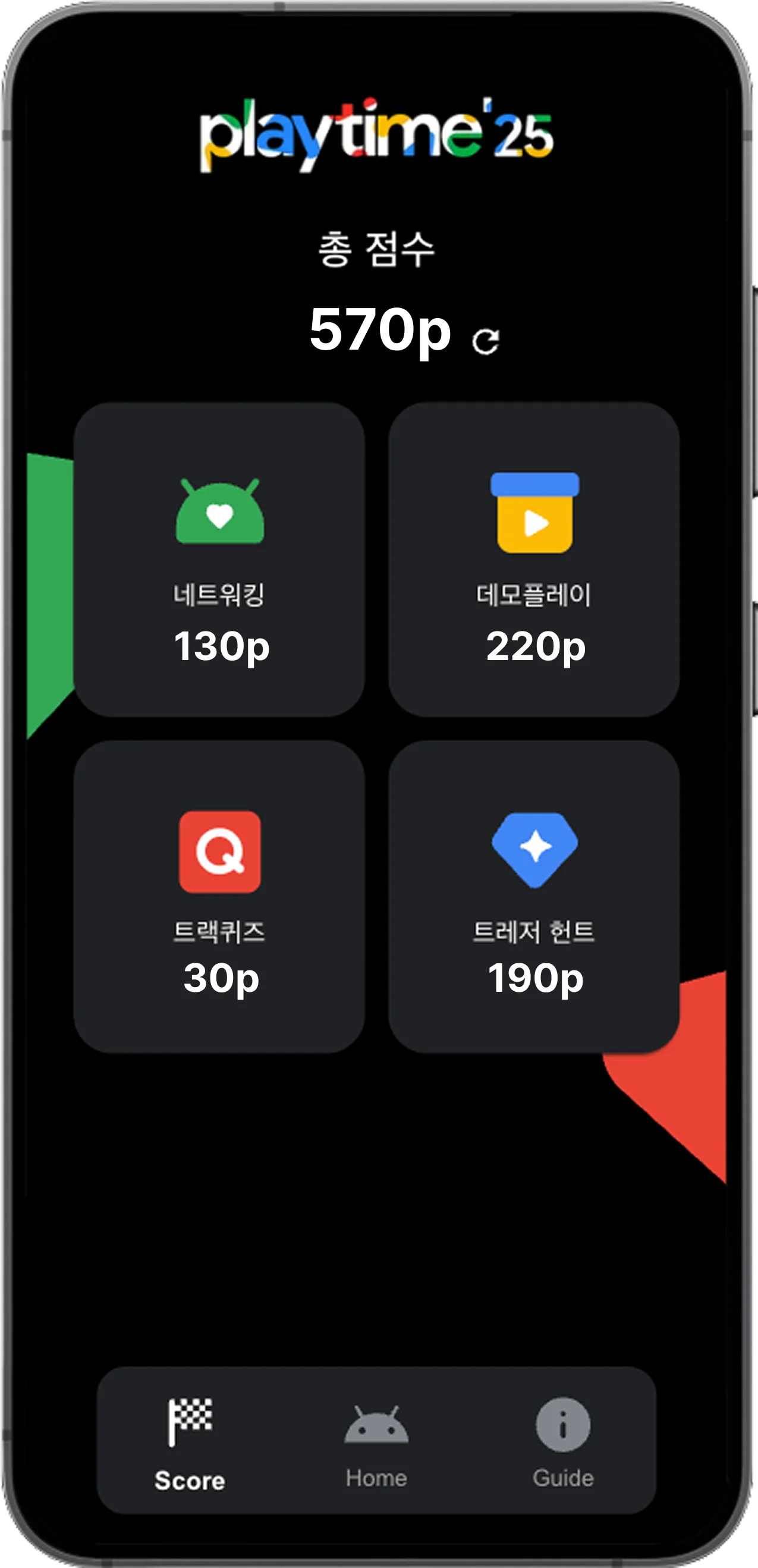
At Google PLAYTIME 2025 Korea, every attendee action was connected to real-time scores and a live leaderboard.
What If NFC Is the Heart of the Event?
Most events prepare a lot of great content. There are sessions, demo booths, networking time, and rewards. But on the ground, this tends to happen:
Attendees sit in their seats during breaks. Booths get visited by only a handful of proactive people. Striking up a conversation with someone you've just met feels awkward. Attending a session doesn't automatically translate into engaged participation. The event is well prepared, but attendee behavior doesn't move as easily as expected.
This is where NFC events come in. NFC isn't just a technology for tapping a smartphone — it's an interface that converts offline actions into digital participation. Tagging a badge turns into networking. Holding a badge to a booth creates a participation record. Finding a hidden tag earns treasure. And all of these actions feed into scores and a leaderboard.
Google PLAYTIME 2025 Korea is the case where this structure was most clearly realized. This was not an event that bolted on NFC as an add-on feature — it was an event where NFC became the centerpiece of the entire experience.
What Was Google PLAYTIME 2025 Korea?
Google PLAYTIME 2025 Korea was an event where domestic developers and industry professionals gathered to experience Google technologies, sessions, and demos. Attendees listened to sessions across multiple tracks, tried hands-on demos at booths set up throughout the venue, and were expected to connect with others who shared similar interests.
Events like this are inherently good events. The content is clear and attendees arrive with purpose. But they're also inherently challenging. Session-heavy events tend to leave attendees sitting passively for long stretches, and demo booth participation tends to cluster around the most proactive attendees. Networking is important, but starting a conversation with a stranger doesn't come naturally to everyone.
So the question this project started with was simple:
Can attendees be made to move more, meet more people, and experience more?
VVFY STUDIO solved this through NFC badges, Androidify avatars, real-time scores, a treasure hunt, demo booth readers, session quizzes, and a leaderboard. Elements that could each stand alone as a main event were combined inside a single event.
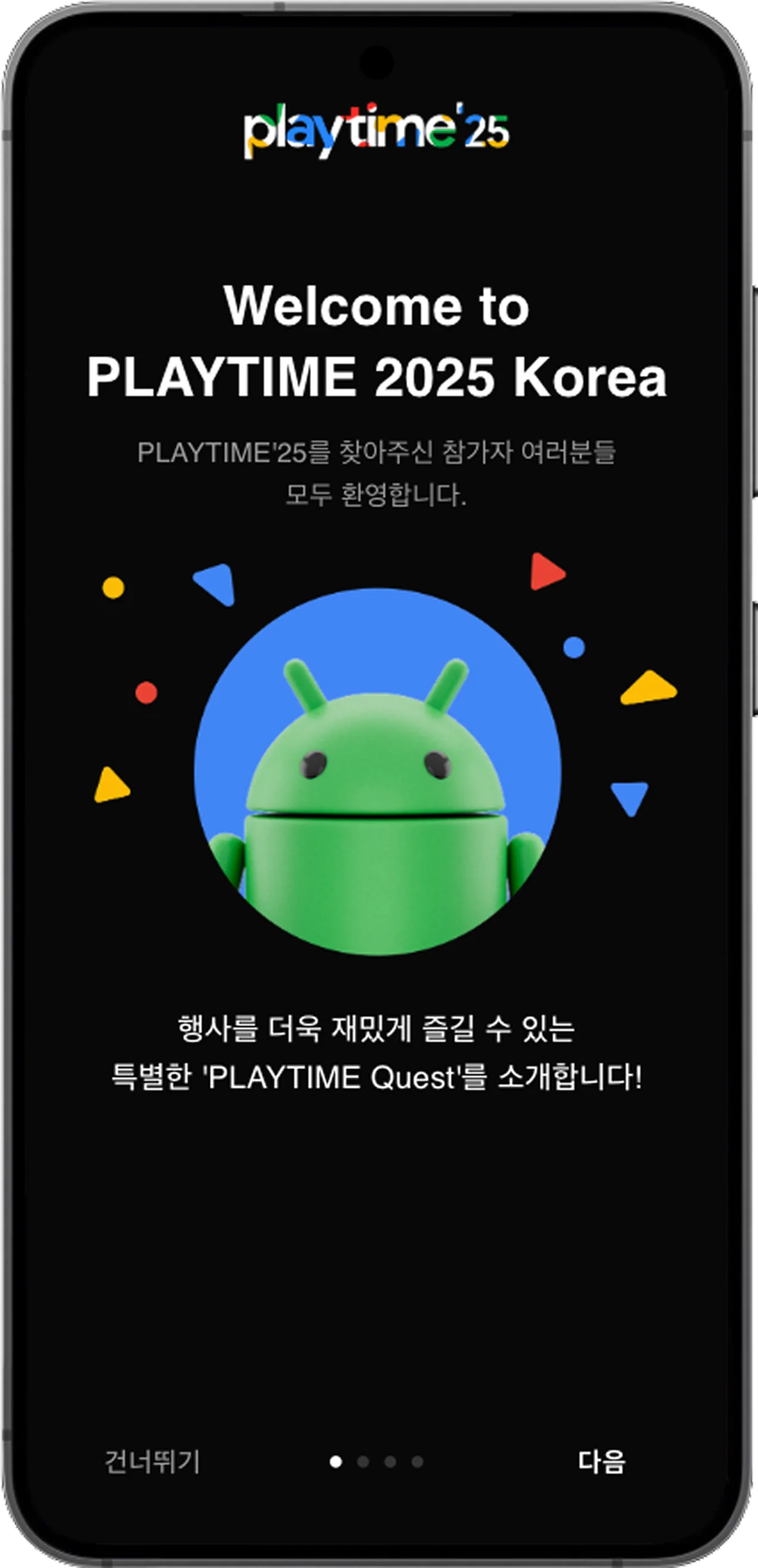
The Problem With a Standard Session Event: Many People, Scattered Actions
The biggest costs of an in-person event are space and time. You rent the venue, build the stage, set up booths, and prepare sessions. But if attendees don't make full use of that space, the density of the event drops.
If attendees stay seated through every break, booth engagement rates fall. If people leave right after a session, what was covered doesn't translate into participation data. Even with a designated networking period, if conversations never start, that time becomes a gap.
At Google PLAYTIME 2025 Korea, NFC changed these problems one by one.
| Event Element | Problem in a Standard Event | PLAYTIME Quest's Solution |
|---|---|---|
| Badge | Serves only entry verification then has no further role | Used as each attendee's personal interface |
| Networking | Conversation with a stranger is awkward | Tagging each other's badges earns points |
| Breaks | Ends as downtime sitting in seats | Transformed into exploration time hunting for treasure across the venue |
| Sessions | Passive experience of listening and leaving | Post-session QR quizzes connect comprehension to participation |
| Demo booths | Only the most proactive attendees visit | Badge tagging at completion earns points |
| Rewards | Final raffle or one-off prizes | Reward structure based on real-time scores and rankings |
The key point isn't that NFC replaced everything. NFC became the central axis connecting attendee actions, while QR, a dashboard, the leaderboard, and Androidify each played their supporting roles around it.
First Shift: The Badge Became a Personal Interface
An event badge normally shows a name and affiliation and confirms entry. At Google PLAYTIME 2025 Korea, the badge played a far more active role. NFC was embedded in each attendee's badge so the badge itself became the interface for starting and recording the event experience.
Through the badge, attendees earned points, networked, logged demo booth participation, and continued experiences linked to their personal Androidify avatar. The badge wasn't a piece of paper hanging around the neck — it functioned more like each attendee's event account.
This difference matters. In a standard event, attendees have to remember each program separately: which booths they visited, which missions they completed, what else they need to do. When an NFC badge becomes the center, attendees only need to tag. Actions become simple, records are logged automatically, and the score screen and leaderboard point to what comes next.
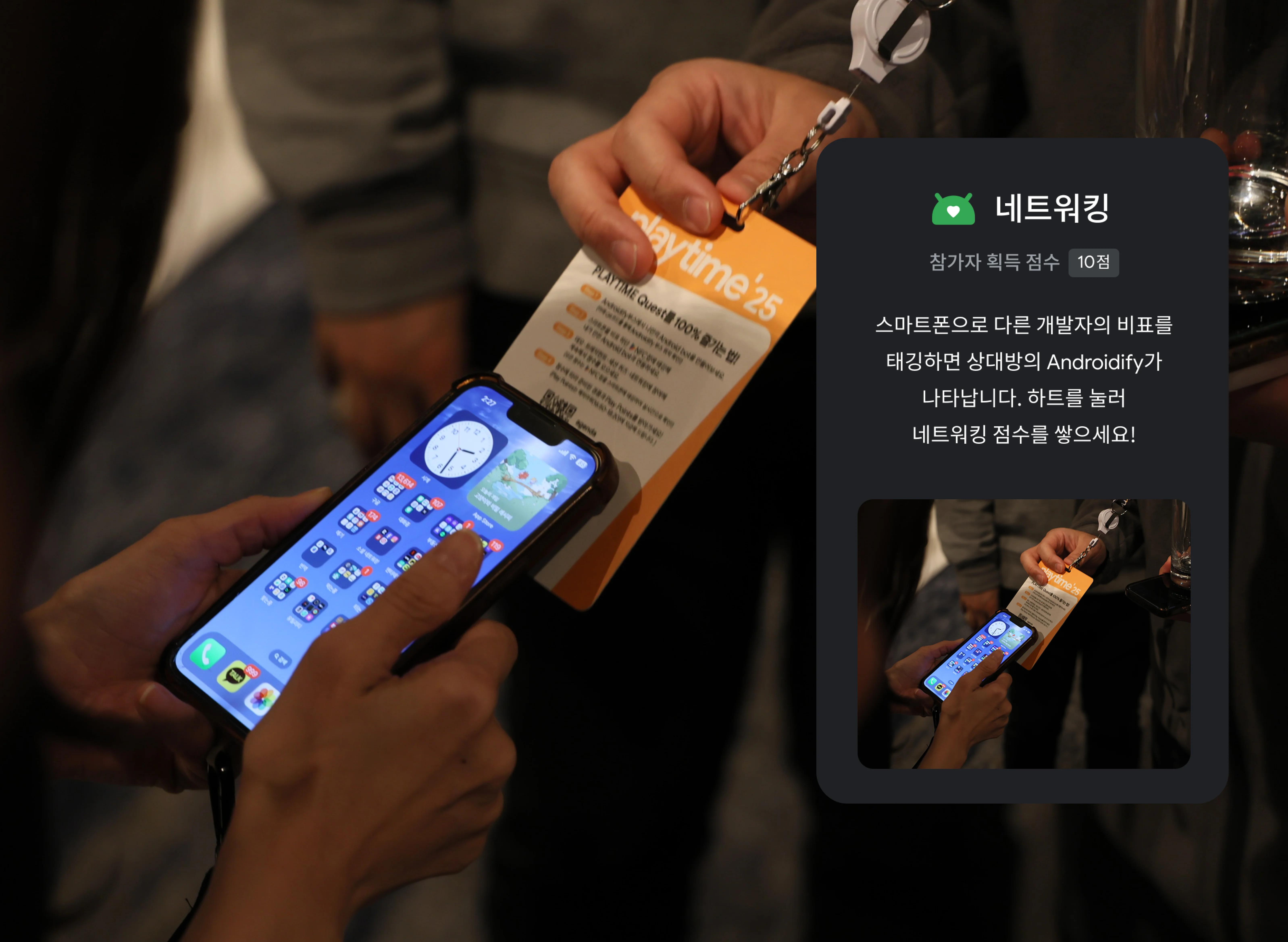
The badge shifted from a tool for identifying attendees to an interface that converts attendee actions into points.
Androidify: Once You Have an Avatar, Points Become a Character's Growth
At the center of this event was the Androidify experience — creating yourself as an Android character. Attendees made an Android avatar that reflected their own appearance and linked it to their badge.
The key here is that the avatar wasn't a simple profile image. As attendees earned points, completed missions, and networked across the venue, they developed a sense of growing their own Android character. When points don't just end as numbers but connect to a character representing you, the motivation to participate becomes much stronger.
Attendees experienced the event not as "I need to collect points" but as "I'm growing my Androidbot." In this context, the NFC badge becomes the bridge between the real you and your digital avatar. What you do inside the venue is directly reflected in the state of your character.
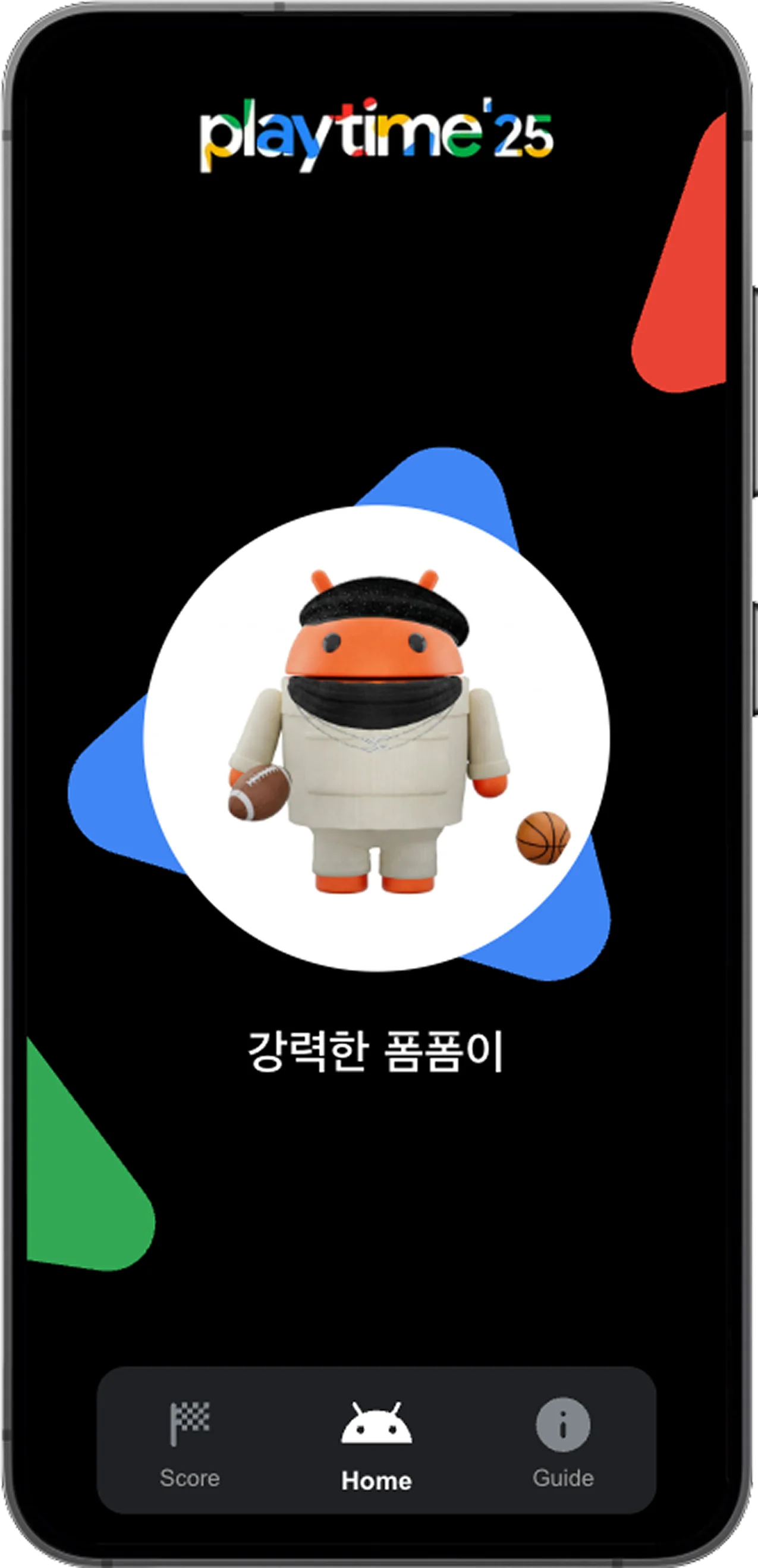
Once you have an avatar, participation becomes personal.
Booth visits, treasure hunts, networking, and session quizzes all accumulate as points, and those points connect to your Android character on screen. Attendees become players growing their own character, not spectators watching an event.
Networking: An Awkward Greeting Becomes a Mission
Networking matters at developer events. But that doesn't mean it happens naturally. Even in a room full of people, starting a conversation with someone you've never met is still uncomfortable.
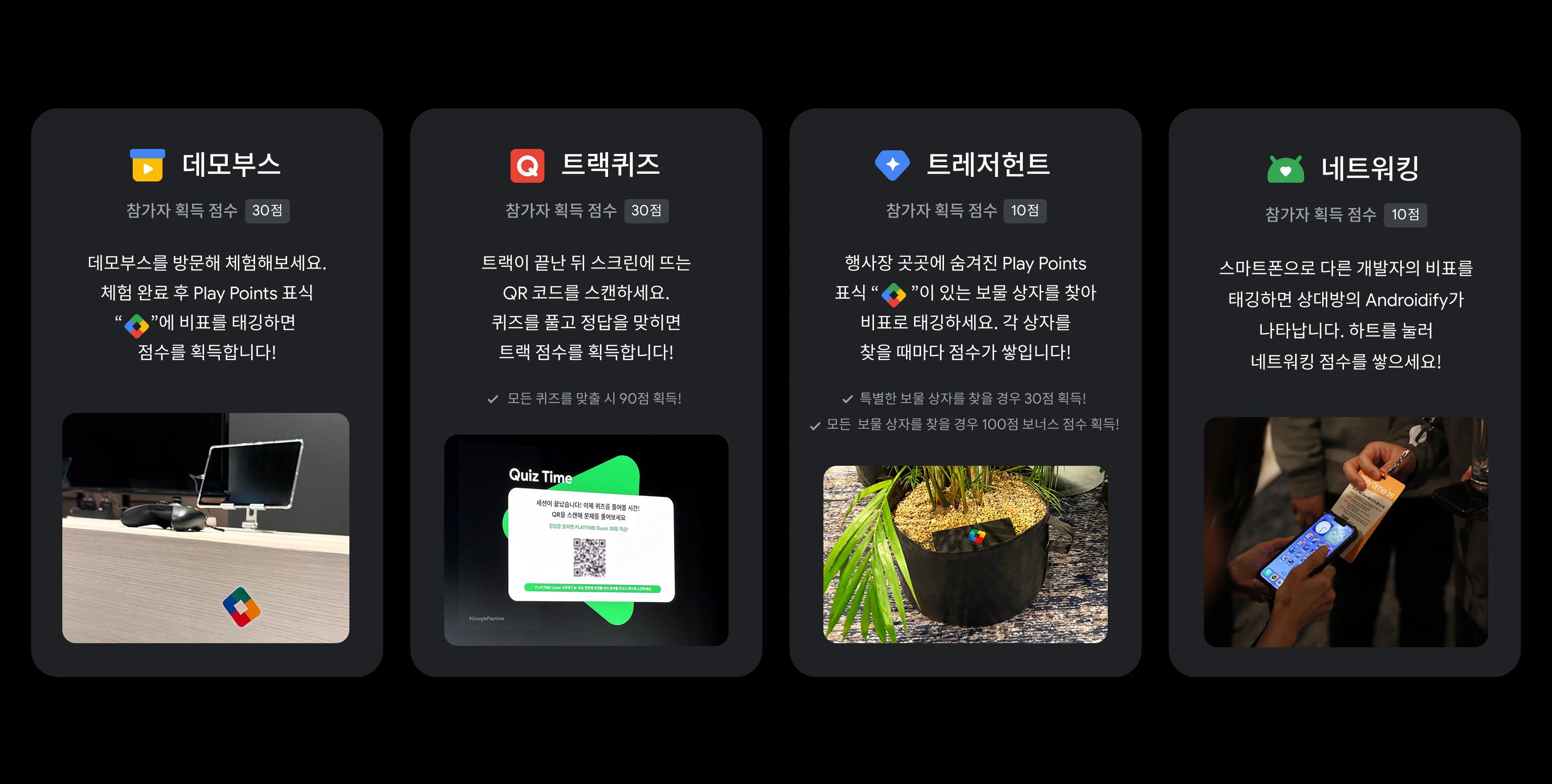
At Google PLAYTIME 2025 Korea, NFC solved this. A structure was built where attendees earn networking points by tagging each other's badges with their smartphones. Tag someone's badge and their Androidify appears on your screen — tap the heart to add networking points.
What makes this structure effective is that it creates a starting point for conversation. "Can I tag your badge?" becomes a natural first line. "Please network" from an event organizer is far less effective than a scoring system and a mission that nudges attendees' behavior more gently.
Networking is no longer a separate designated period — it becomes a repeated game action throughout the entire event.
Treasure Hunt: Break Time Becomes Time to Move Through the Whole Venue
Break time between sessions is the hardest time to manage in event operations. People are tired, they want to sit and rest, and motivation to explore booths or wander the space is low. But from the event's perspective, that time is also the best opportunity to make the space come alive.
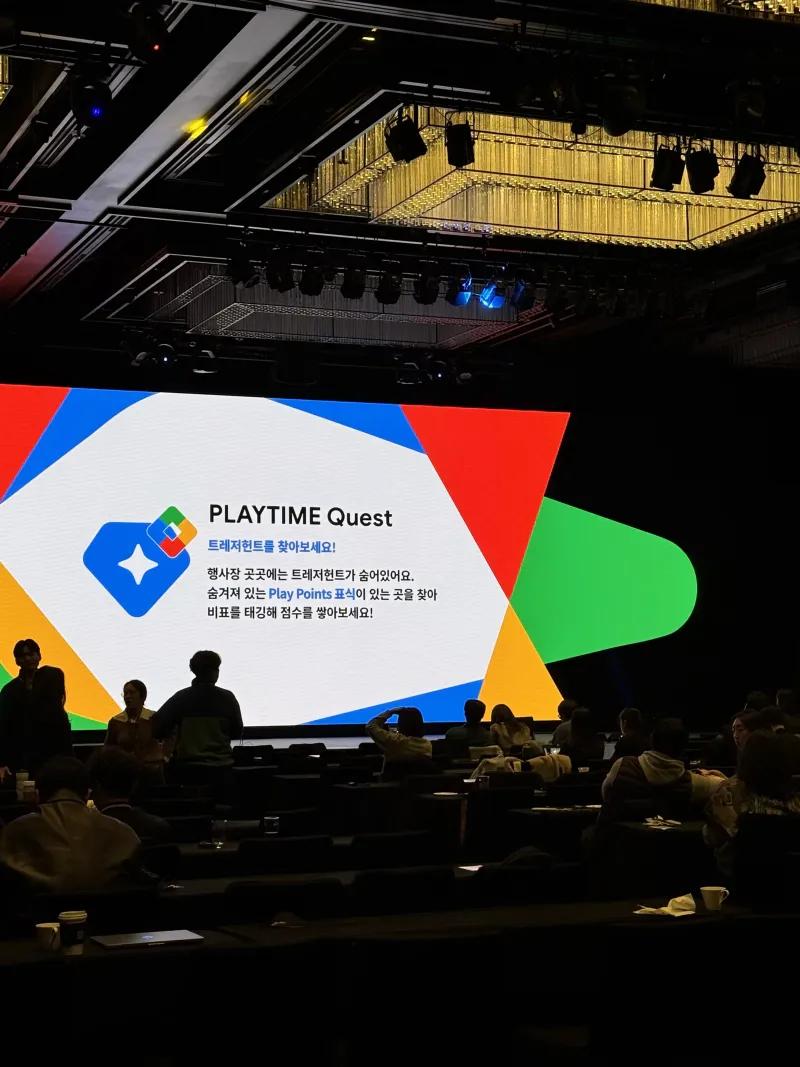
PLAYTIME Quest hid treasures across the venue. During breaks, attendees searched for hidden Play Points tags, tapped their badges, and earned points. Finding a special treasure or collecting all of them unlocked additional bonuses.
With this in place, break time is no longer just rest time. It becomes time for attendees to walk the venue, cross paths with others, pass near booths, and explore the entire space. The whole venue becomes a single game board.
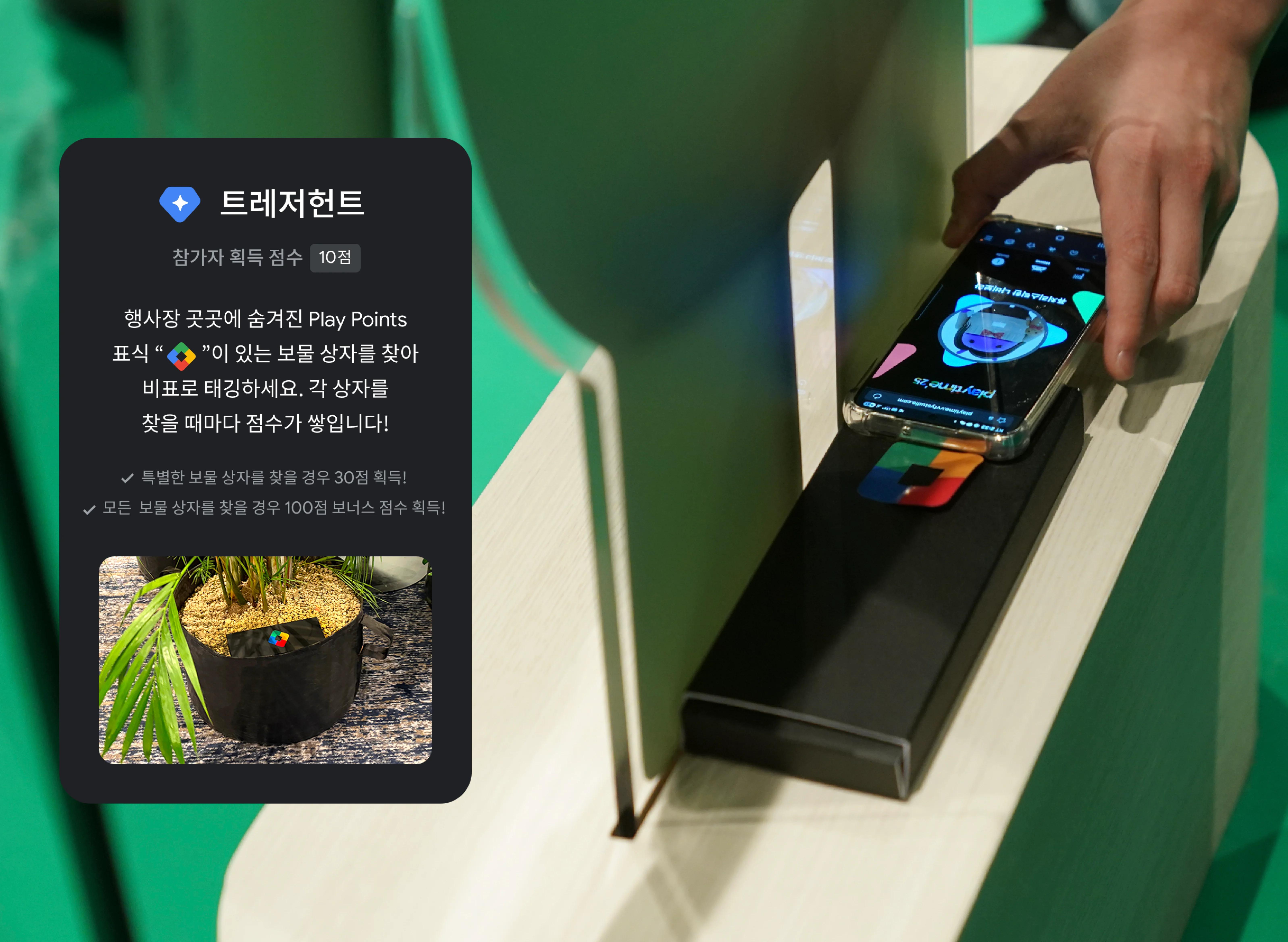
The treasure hunt turned break time into movement time and raised the spatial utilization of the entire venue.
Session Quizzes: You Have to Pay Attention to Earn Points
Sessions are the substance of the event. Introducing Google technologies, helping attendees understand the content, and giving them something concrete to take away — that's what matters. So it's a shame when the session experience ends at simply "attended."
In PLAYTIME Quest, when a session ended, a quiz tied to that session opened. Attendees scanned a QR code shown on the venue screen, answered the quiz, and earned points for correct answers. QR was the better fit for this stage because many people needed to simultaneously access a single screen.
What mattered was that the scoring structure raised session engagement. Knowing a quiz is coming makes attendees listen more actively. After the session, they immediately verify what they just heard, and the result reflects in their score and leaderboard position.
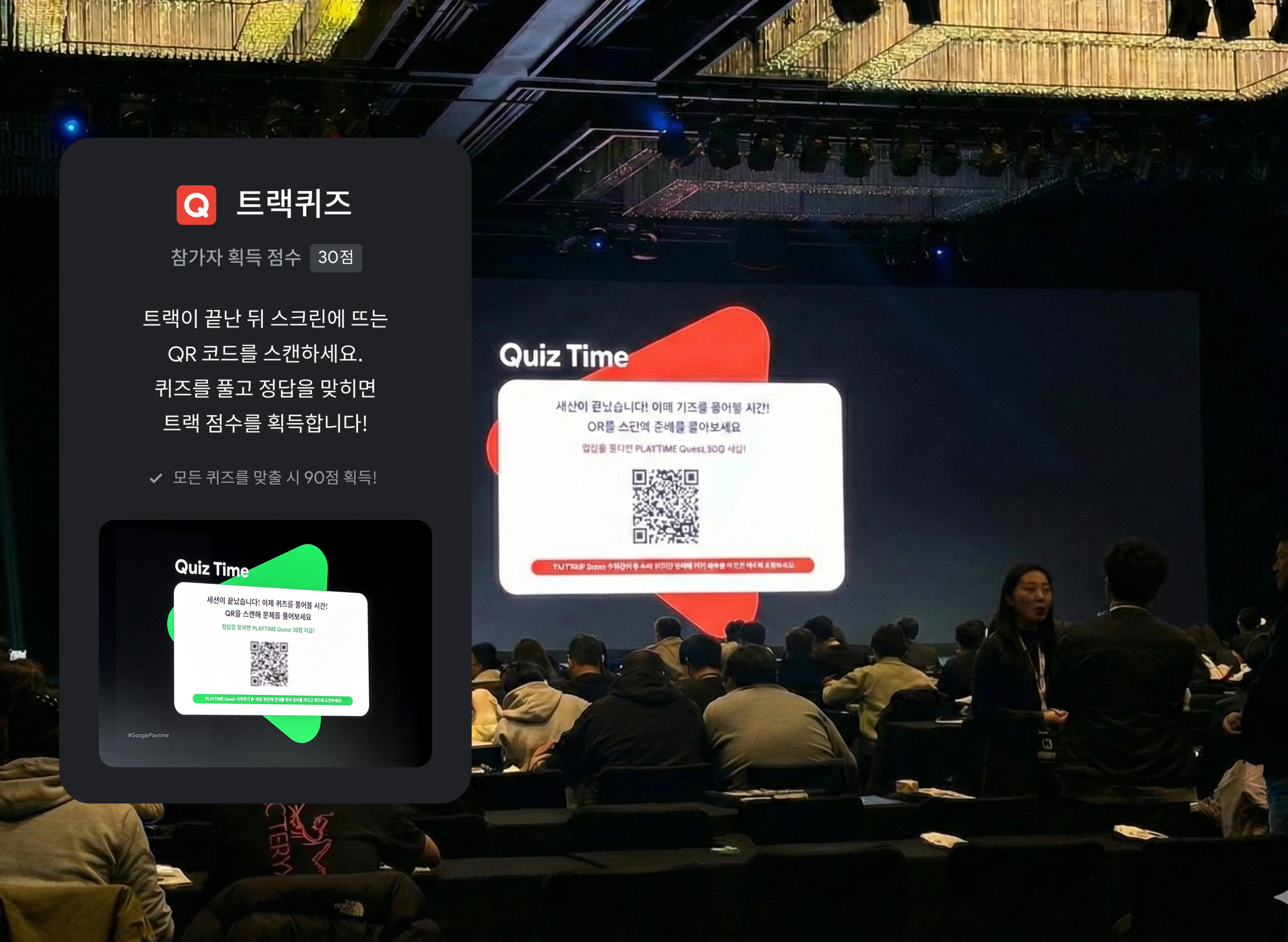
Session quizzes required large-scale simultaneous access, so they were opened via QR, with results feeding into the overall scoring system.
Demo Booths: Technology Experiences Logged as Scores
Google's newest technologies and demo experiences were presented at booths set up across the venue. The challenge is that with many booths, it's hard for organizers to see at a glance which booths attendees visited and how actively they engaged.
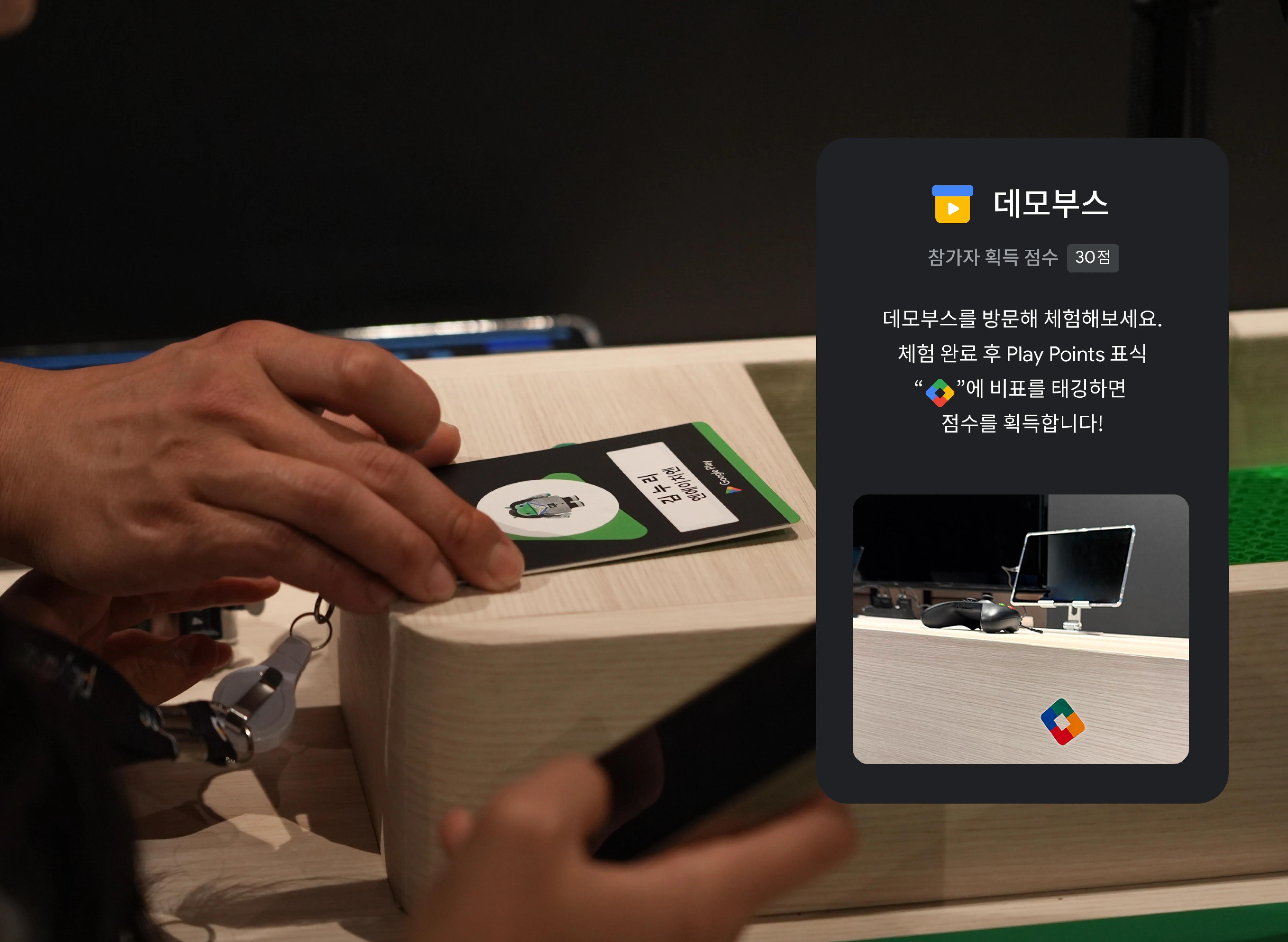
For this event, the design was for attendees to earn points by tagging a Play Points marker with their badge after completing a demo experience. After finishing a demo, they held their badge to the NFC reader, and the system instantly logged their participation.
This structure benefits booth operations too. Attendees visit more booths to earn more points, and organizers can check in data which booths saw the most active participation. It becomes more than simple check-in confirmation — it's a participation flow where technology experiences, scores, and the leaderboard are all connected.
And One More Thing: All of This Ran Inside a Single Event
The most striking aspect of this case study isn't the novelty of any individual feature. It's that networking points, Androidify avatars, a treasure hunt, session quizzes, demo booth tagging, a real-time leaderboard, and final prize distribution were all connected inside a single event through one unified scoring system.
Any one of these alone could be a standalone main event.
- NFC badge networking alone makes a full icebreaker program for a developer event.
- Androidify avatars alone make a personalized participation experience.
- A treasure hunt alone makes a spatial exploration event.
- Session quizzes alone make a learning participation program.
- Demo booth tagging alone makes a reward system for improving booth engagement rates.
- A real-time leaderboard alone makes a competitive event format.
Yet at Google PLAYTIME 2025 Korea, all of these ran as one continuous flow. Attendees walked in with a badge around their neck, built themselves in Androidify, attended sessions, took quizzes, tried demos, hunted for hidden treasures, and tagged other attendees' badges. And they checked all of those results on real-time score screens and the live venue leaderboard.
When prizes were given to the top scorers at the end, points became not just a number but the motivation driving the entire event.
Why Is This Case Study the Model for a Perfect NFC Event?
A highly realized NFC event doesn't end at "tag and a page opens." It needs to be clear why attendees should tag, what changes when they do, and how that action connects to the event's purpose.
The structure of Google PLAYTIME 2025 Korea was a strong fit between the event's core purpose and NFC's role.
| Event Purpose | NFC Event Design |
|---|---|
| Introducing Google technologies | Demo booth experience logged as completed via NFC reader tagging |
| Session engagement | Post-session QR quizzes connect comprehension to score |
| Attendee networking | Tagging each other's NFC badges connects greeting to point earning |
| Venue exploration | Treasure hunt using hidden NFC tags expands attendee movement |
| Personalized experience | Androidify avatar linked to badge provides a player experience unique to each attendee |
| Participation motivation | Real-time leaderboard and final prizes drive competitive engagement |
| Operational data | Booth visits, networking, treasure hunts, and quiz participation accumulated as scores and records |
What matters most in event planning isn't fitting in as much technology as possible. It's naturally increasing attendee action without undermining the event's purpose. In this case, the core of the event — introducing Google technology, session participation, demo experiences, and networking — was made stronger through NFC.
That's why this event is less a simple example of NFC implementation and more a case where NFC changed the operating logic of the event itself.
NFC and QR Are Not Competitors
Something worth noting in this event is that not everything was handled with NFC. Session quizzes used QR. The reason is clear: when many people need to simultaneously scan a code displayed on a session screen, QR is faster and more familiar.
Conversely, for actions where real physical contact and on-site presence matter — badge tagging, booth completion authentication, a treasure hunt, networking — NFC was the better fit.
| Situation | Better Fit | Reason |
|---|---|---|
| Individual identification through attendee badge | NFC | Well suited to directly linking badge to action |
| Attendees tagging each other for networking | NFC | Physical contact becomes the starting point for conversation |
| Demo booth completion authentication | NFC Reader | Completion can be instantly recorded on-site |
| Venue treasure hunt | NFC | Creates an experience of actually finding hidden tags |
| Large simultaneous access after a session ends | QR | Easy for many people to access at once from a large screen |
Good event design isn't about choosing between NFC and QR. It's about identifying which actions suit NFC and which suit QR.
What to Decide First When Planning This Kind of Event
To build a successful NFC event, the flow needs to be determined before the product. Before making the badge, decide what actions attendees will be guided through.
- What are the core actions attendees must experience?
- Do those actions belong to sessions, booths, networking, or rewards?
- Which actions will be logged through NFC tagging?
- Which actions are better opened through a method suited for mass access, like QR?
- When do attendees check their personal score screens?
- Where is the leaderboard displayed?
- By what criteria do scores accumulate, and how are final rewards distributed?
- How will participation data after the event be used for follow-up marketing or reporting?
Answering these questions naturally clarifies the scope of NFC badges, NFC stickers, NFC reader systems, mobile web, admin dashboards, leaderboard displays, and reward policies.
Conclusion: NFC Is the Mechanism That Makes Events Move More
The goal of an NFC event isn't to create a novel tagging experience. It's to make attendees move more, meet more people, try more things, and remember it longer.
Google PLAYTIME 2025 Korea demonstrated that goal with exceptional clarity. Badges became personal interfaces. Androidify avatars personalized participation. Networking became a mission. The treasure hunt made break time into movement time. Session quizzes raised engagement. Demo booth tagging turned technology experiences into data. And all of these actions connected to a real-time leaderboard and final prizes.
That's why this case study is close to VVFY STUDIO's model for a perfect NFC event — because NFC was placed at the center in a way that didn't dilute the event's purpose but made it stronger.
If you're preparing an NFC-based developer event, brand conference, popup event, or demo booth reward system, start with the Google PLAYTIME 2025 Korea portfolio. If your project requires designing badges, content, on-site readers, mobile screens, and a leaderboard as a single unified structure, send your event purpose and operating scope to VVFY STUDIO and we'll help you map it all out.
Related Posts
- 2026 Complete Guide to NFC Keyring Production
- Secure NFC vs Standard NFC: The Owner Experience Where Tagging Works Like a Login
- NFC Keyring Content Design: Building a Structure That Makes Customers Tag Again Daily
- How Physical Goods Drive Offline Visits: DONDONZ NFC Popup Reward Strategy
- NFC Links Can Be Changed Even After Production
Shall we build your brand NFC project together?
Let's create something new for your brand with VVFY STUDIO.
Start a project consultation